
Earning Eagle Scout is a remarkable achievement. Earning Eagle Scout, Sea Scout Quartermaster, and the Venturing Summit Award is even rarer. At the 2026 National Scout Jamboree, John Rongish completed that extraordinary journey.
A Rare “Hat Trick”
John Rongish was already part of an elite group of scouts who have earned their Eagle Scout award and Quartermaster (Sea Scout) award. During Jamboree, Rongish added his Venturing Summit award to the list, completing what he termed a “hat trick.” In hockey, a “hat trick” is when a player scores three or more goals in a single game, a rare feat.
Eagle Scout During COVID
Rongish had been SPL for two years, and for his Eagle project, worked with local businesses to redo a stone rock grotto for his church that took over a year to complete. At age 14, Rongish earned his Eagle on September 1, 2020, right at the start of COVID.
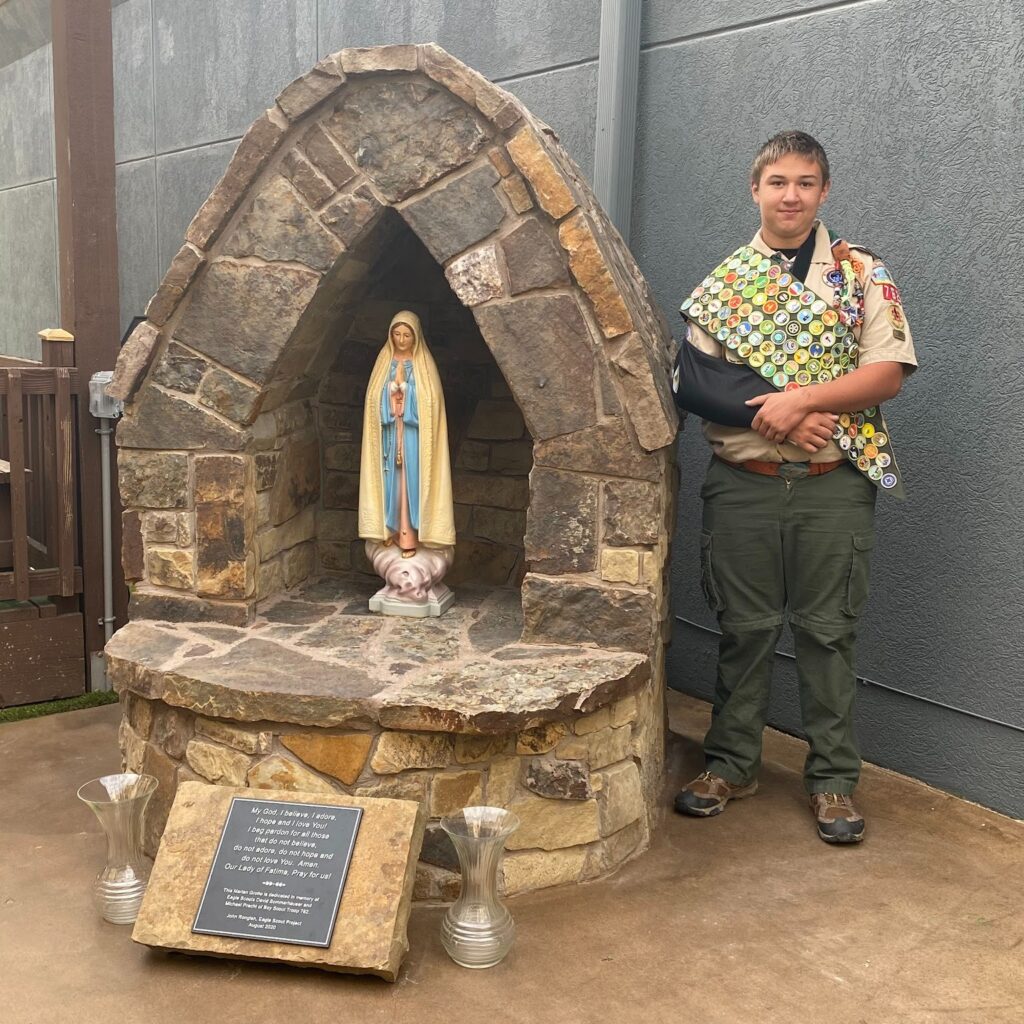
John Rongish posing next to his completed Eagle Scout project
Soon after, members in his troop heard of Sea Scouts and thought it’d be fun, so they started a Sea Scout ship. They figured being on their sailboat was the perfect way to social distance while also spending time together. Having sailed as a youth outside of scouting, Rongish figured he already knew some of it, so why not start working on the next rank?
For his Quartermaster’s Cruise, a required 40 consecutive-hour trip with four or more people, including two nights on the water, planned and captained by the Sea Scout.
“So we would like, for ours, you know, we’re on a 25-foot sailboat. So we would just go out, sail during the day, come back in for a meal, and then go back out. It’s basically just planning a campout. If we were in Florida, it would have been a lot cooler, you know, it could have stayed out, like, Sea Base, you know.“
Rongish achieved his Quartermaster rank again on September 1st, 2022, exactly two years after his Eagle.
Finding New Challenges Through Venturing
Rongish loves to fish and in 2023, took a certified angling instructor class, taught by James Goff. Goff was in charge of a Venture Crew focused on fishing. Scout involvement was down, so Rongish and Goff decided to broaden it to include a conservation focus as well as fishing to allow them to do more.
Again, Rongish quickly rose through the ranks.
Rongish remembers his final Tier-II and -III adventures. On one, Rongish had to plan a 72-hour trip, which became a trek from Kansas to Florida to go to the last Powderhorn, a high-adventure course.
Next, a conservation project. Rongish organized his crew to repopulate walleye in a local lake. Rongish and his friends were “literally squeezing the eggs out of a fish, you know. They’re not going to forget that.”
Finally, a lifelong friend of his grandmother needed help at home to clean out rooms where hoarded items piled up to make them livable again, to repair plumbing and turn the water back on.
“(Managing a project) does get a lot easier after (earning your) Eagle, especially when you do it young. It helps you develop a lot, and you know how to tackle these problems, and how to plan something.”
For his Board of Review, Rongish said it just kind of fell into place. He thought about holding the BOR on September 1, like his prior two, but all of his crewmates were here at the Summit for Jamboree. He figured,
“Why not earn Summit at the Summit?”
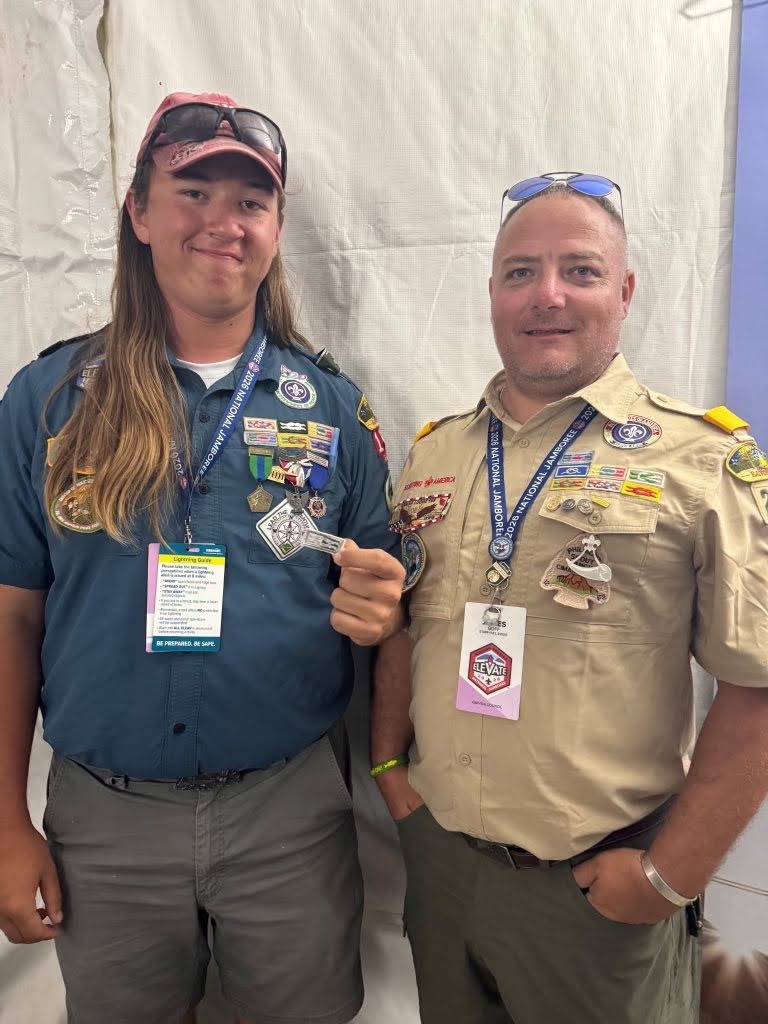
John Rongish, left, with his Venture Crew Advisor James Goff
An Extraordinary List of Accomplishments
As the historical average percentage of Scouts attaining the Eagle Scout rank hovers around 4%, one can infer those that achieve the “triple hat” are far, far, far fewer.
Now take this a step further.
Add to those achievements the number of Scouts who earned all available merit badges. Rongish earned 139, which is one more than was available at that time. This is because the Medicine merit badge was changed to Healthcare Professionals, and Rongish earned both.
Finally, as OA Lodge Chief, Rongish’s lodge nearly doubled membership within two years, from 204 members increasing to 360.
The Secret: A Little Bit Every Day
Asked how he was able to achieve all of this, Rongish said he just did a little bit at a time, maybe ten minutes on one thing, then bounce to another.
Rongish says he recalls Goff’s saying often,
“If you practice anything for ten minutes a day, you’ll be better than 99% of everybody else.”
Over time, the work adds up.
Rongish also said it helps to prevent burnout if you can switch often between what you’re doing…a little bit here, a little bit there, and you stay excited; you don’t get bored working on just one thing.
Planning for Success
Rongish also planned.
When a merit badge college would come up, he would look to see what badges he could take. Or for summer camp, he said you can do five badges or so, but all the counselors for the other badges are there. So you can do some or all of the work at home or at other times at camp and then see the counselor with your workbook, prepared to answer questions to prove you’ve met the requirements.
For example, Rongish did the basketry merit badge on his own, then found the counselor during lunch and asked if he could verify the requirements then.
He also said you can look at the requirements of every merit badge and see what you’re already doing. For example, doing the Rayado hike at Philmont, a 20-21 day trek for experienced Scouts, checks off requirements for the Hiking merit badge.
“The day-to-day was really just, I don’t know, making a list.”
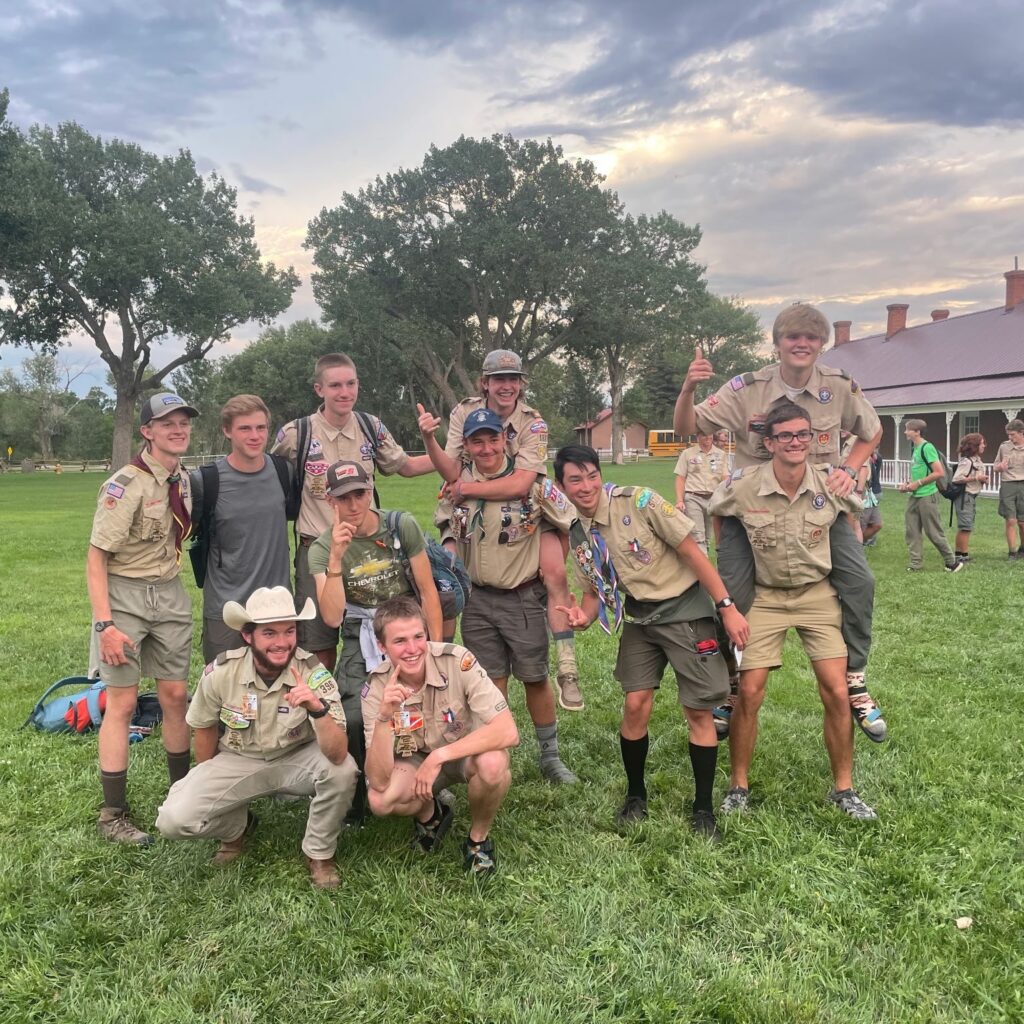
John Rongish, center, with his Venture Crew at the Rayado Trek at Philmont
Lessons That Last a Lifetime
When times became tough, he fell back on the OA saying “Cheerful Service.” He thinks back to his experience at Philmont:
“Expect the unexpected,” and “Put your head down and hike.”
Rongish notes that though this works on the hiking trail, these sayings also work at home for when you need to just get things done.
“Swallowing the frog for breakfast, it’ll be the worst thing you do that day, so do the hard stuff first.”
Even simple tricks help, like during the Rayado trek, to deflate your sleeping pad so you don’t want to lie in bed all morning.
“You know, it’s 5:30 in the morning, and I want to get up, I just roll out of bed, you know, before I’m awake. So there’s weird little things like that where I don’t think of ‘this came from this,’ but so many little skills on the whole, from every experience.”
Living the Scout Oath Every Day
Ronish remembers how he had written his OA oath and put it in his wallet, now a worn piece of paper over the years.
He said he’s not just going to say the oath once; he wanted to live it. He was bothered that each time they had a meeting, others would need a copy of it to read from. If he took an oath, he was going to live that oath every day.
A Growth Mindset
Rongish also has quite the growth mindset.
“I don’t take no for an answer or that I can’t do something…I always find a way, figure something out.”
“What I love about scouting is that it’s a safe place to fail. And you get all these opportunities…to get experience in many little things.”
Rongish recalled when he took the Plumbing merit badge, he didn’t know anything about it…he didn’t know what a p-trap was for. And maybe a year after completing it, a toilet in his house broke and,
“Instead of asking my dad, I was like, ‘What’s wrong with it? I’ve seen a toilet before, maybe I can figure it out.’”
On earning merit badges,
“What’s great is you have all these opportunities to learn these little things, and you build confidence in yourself and your ability to learn.”
It Started with One Question
When did it all begin?
Rongish recalls he was “a terrible Cub Scout” earning “maybe two or three belt loops.”
However, Rongish remembers when he was early on in Scouts BSA, he saw an older scout who had “like a ton of merit badges. And I was eleven years old, like two months into being a scout. And I was like, ‘That’s awesome. Can I do that?’ And my mom was with me, and she said, ‘I don’t know, you could try.’ And so I tried, and it worked.”
A Mother’s Perspective
Rongish’s mom Sandy recalled when John was considering how to plan for his future,
“Maybe a hundred merit badges, and John goes, ‘Could I do that?’ And I was like ‘Oh man, that’d be a lot of work.’”
She says having brothers who became Eagles and other boys who earned a lot of merit badges gave him the motivation he needed.
She recalls Rongish rarely ever missed a meeting or campout; once, he had a mandatory band performance, and two others where he had broken his arm from a prior Scout trip. Only three missed meetings in all those years.
Mrs. Rongish laughs at how just a few weeks before breaking his arm, he had told her how to make a sling with a Scout neckerchief. So when
“Somebody came in and said, ‘Mrs. Rongish, John broke his arm,’ I ran in there and thought, ‘I got this covered.’ And I took my neckerchief off, tied a sling, and drove him to the ER.”
Looking Ahead
Asked where he goes from here, Rongish said he is currently attending Wichita State University, majoring in electrical engineering, but he already has plans for what he wants to do next in Scouting.
He noticed how during COVID, many troops “kind of forgot how to do scouting. A lot of little things, like how you line up, how you do flags, how you do patrol cooking, duty rosters, things like that…how to set up a dining fly” due to the two-year gap.
He wants to develop something to bring these skills back, both for the Scouts and leaders.
Other areas of interest are continuing to serve on the National Fishing Committee, doing media communications for them as well as his council. He goes to events, takes pictures, and posts information to get the word out.
Final Thoughts
As the conversation wrapped up, it became clear Rongish wasn’t hyperfocused on achieving all that he accomplished. He just did the program – he went to the meetings. He worked on the merit badges little bits at a time. He looked forward and made plans. When times got tough, he used mantras and past experiences to remind himself he could do it.
And finally, his mom added,
“He likes following what’s written. Somebody told him, ‘Do what’s written, read the material and the magic will happen.’ And it did.”